GTA 6 Price Shock Meets PS Plus Hike: The Moment Gaming Became a Luxury Subscription Economy
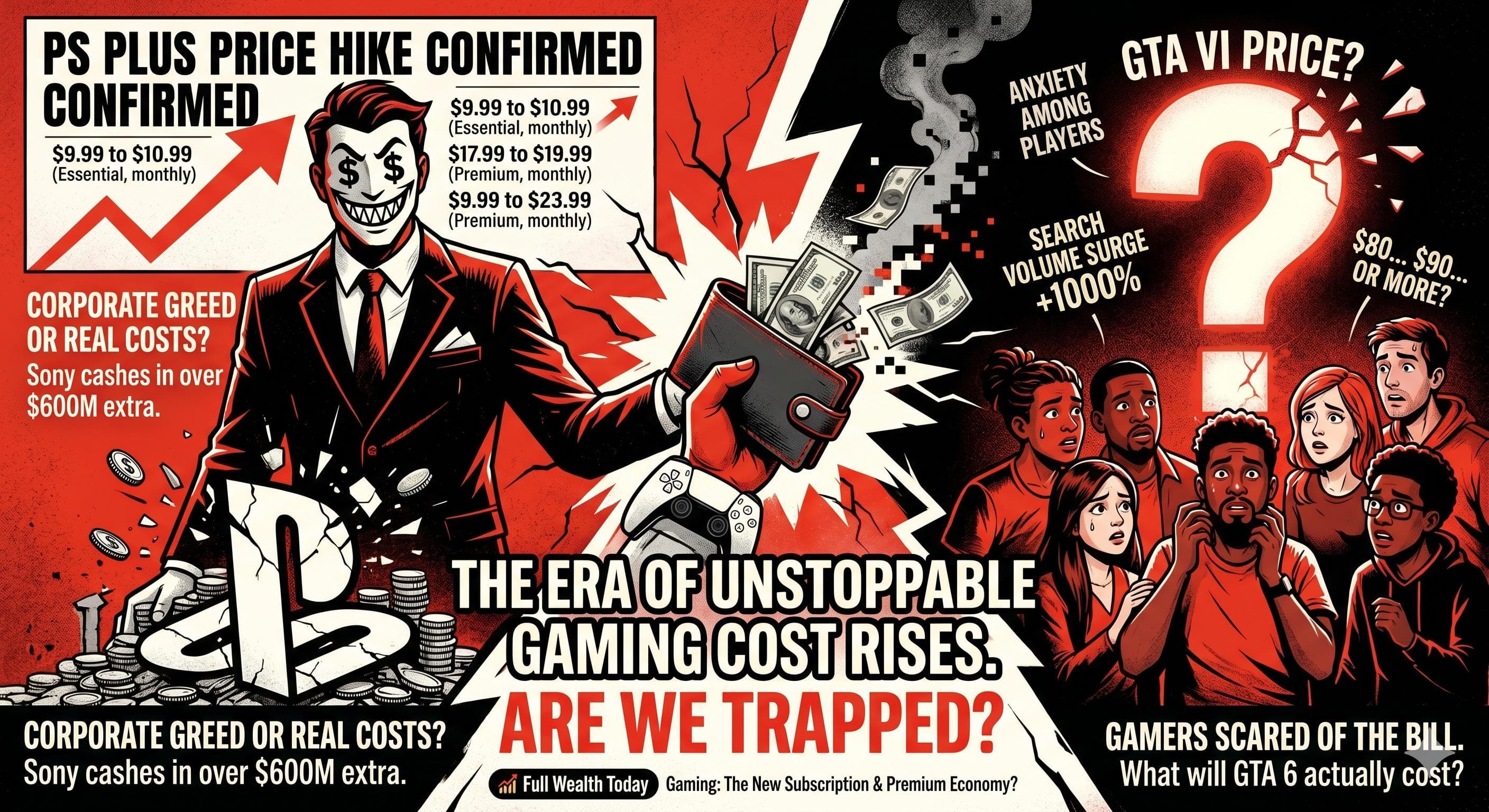
Two seismic forces are colliding in the gaming industry right now, and the shockwave is hitting consumers directly in the pocket. Sony has officially confirmed price increases for PlayStation Plus across its monthly and quarterly subscription tiers, while the internet is ablaze with speculation — and anxiety — around what GTA 6 will actually cost at launch. Search volume for "gta 6 price" surged over 1,000% in a single day. That number doesn't lie: people are scared.
This isn't a minor irritation. It's a structural inflection point in the console gaming economy. Welcome to the era where playing games has officially entered the subscription-and-premium pricing model that already defines streaming, software, and cloud services.
The PS Plus Price Hike: What Sony Actually Changed Sony's PlayStation Plus price increases are now confirmed across multiple subscription tiers. The monthly plan for PS Plus Essential, Extra, and Premium has risen — with the one-month and three-month plans absorbing the steepest relative increases. According to reports cited by the BBC and multiple gaming outlets, the monthly Essential tier has risen from $9.99 to $10.99, while higher tiers like Extra and Premium have seen proportional jumps that compound dramatically over a 12-month period.
Sony's rationale follows a now-familiar corporate playbook: rising content licensing costs, server infrastructure investments, and the need to fund its increasingly aggressive first-party game development pipeline. The irony is that PS Plus's value proposition has actually expanded — monthly free games, cloud saves, and expanded PS Now libraries — yet consumers feel the squeeze regardless.
"A 10% subscription increase sounds negligible. Compounded across 50 million PS Plus subscribers globally, it generates an estimated $600M in additional annual revenue for Sony — with zero marginal content cost." — Full Wealth Today Analysis PlayStation 5 controller on dark surface representing gaming subscription economy GTA 6 Price: Why the Internet Is Panicking Grand Theft Auto VI is not just a game. It is the most anticipated software release in the history of entertainment — and Rockstar Games and Take-Two Interactive know it. With the trailer confirming a 2025 launch window for PS5 and Xbox Series X, the question of price has become a flashpoint for the entire industry's future.
The benchmark in play: $70 as the current-gen standard, set in 2020 by Sony itself for PS5 titles. The whispers — now escalating to credible analyst projections — suggest GTA 6 could launch at $79.99 or even $89.99. Take-Two Interactive CEO Strauss Zelnick has repeatedly stated that games are "underpriced" relative to their entertainment value, laying the ideological groundwork for a premium launch.
If GTA 6 launches at $80+, it will immediately become the industry's new psychological price ceiling — and every major publisher will follow. This isn't speculation; it's how the AAA pricing ladder has worked since the SNES era. One market leader breaks the ceiling; the rest climb through it within 18 months.
The Take-Two Premium Argument — And Its Limits The publisher's case for premium pricing is not without merit. GTA V — released in 2013 — has generated over $8 billion in lifetime revenue at a $60 entry price. The inflation-adjusted equivalent of that $60 price in 1983 dollars (when the industry formed its current pricing norms) is substantially higher than $80 today. Development costs for GTA 6 reportedly exceed $2 billion, making it the most expensive game ever produced. The economics are real.
However, the consumer math tells a different story. A gamer who subscribes to PS Plus Premium, buys GTA 6 at $80, and purchases the inevitable Shark Card bundles for GTA Online multiplayer is now spending over $200 in year one just to access the flagship console experience. This is a different economic reality than 2013.
The Subscription Economy Trap: A Systemic View What's happening in gaming mirrors the broader "subscription stack" problem that is quietly eroding household discretionary budgets across North America and Europe. The average US consumer now maintains 4.5 active entertainment subscriptions, according to recent consumer finance studies. Gaming is no longer a standalone purchase — it's a layered cost structure.
Financial data and charts representing gaming subscription cost analysis Consider the full annual cost stack for a modern console gamer in 2025:
PS Plus Essential (annual): ~$79.99 | PS Plus Extra (annual): ~$134.99 | PS Plus Premium (annual): ~$159.99 | GTA 6 base purchase (projected): $79.99–$89.99 | 2-3 additional AAA titles: $180–$270 | DLC / microtransaction average: $60–$120
Total annual spend for a fully-engaged PS5 gamer: $500–$650+. This is the new baseline. And it is growing.
Who Wins, Who Loses — The Market Stratification Price increases in gaming do not affect all consumers equally, and the market knows it. The industry is deliberately stratifying into two tiers: the premium console ecosystem (PS5, Xbox Series X) where prices are rising, and the free-to-play + mobile economy where the barrier is zero but monetization through microtransactions is maximized.
The middle — the $30–$50 mid-tier boxed game — is being systematically eliminated. Publishers cannot justify that price point against their cost structures. The result is a barbell market: pay premium, or play free-to-play. Casual-to-moderate gamers are being squeezed out of the traditional purchase model entirely.
The Xbox Game Pass Counterpunch Microsoft's strategic response to this moment is Game Pass — and it's gaining relevance precisely because of Sony's price actions. Game Pass Ultimate at $19.99/month provides access to hundreds of titles including day-one first-party releases. If GTA 6 ever lands on Game Pass (highly unlikely at launch but speculated for a 12-18 month window), it would fundamentally alter the competitive landscape. For now, Sony holds the exclusivity advantage on Rockstar's flagship.
Actionable Intelligence: How to Navigate the New Gaming Cost Reality
-
Lock annual subscriptions now. PS Plus annual pricing offers 30–40% savings over monthly billing. With price increases already confirmed, annual plans purchased now lock in current rates until renewal.
-
Wait-and-watch on GTA 6 pricing. History shows AAA launch prices drop 25–30% within 6 months via sales, bundles, or retailer competition. Patience is a legitimate financial strategy here.
-
Audit your subscription stack. If you hold PS Plus and Xbox Game Pass simultaneously, calculate actual usage overlap. Dual subscriptions cost $360–$480/year in premium tiers — rationalize before the next price cycle.
-
Monitor Take-Two's earnings calls. Strauss Zelnick's public statements on game pricing are reliable forward indicators. Track quarterly guidance for signals on GTA 6's official price positioning before it's announced.
The Macro Signal: What This Tells Us About Consumer Tech Inflation Gaming is a leading indicator, not a lagging one. Every sector of digital entertainment — streaming, music, cloud software — has undergone the same cycle: subsidized growth, market consolidation, then price normalization at a higher baseline. Gaming delayed this cycle longer than most because of the retail boxed-game tradition. That era is structurally over.
For investors, the signal is clear: Sony, Take-Two, and Microsoft are transitioning from transaction-based to recurring-revenue models. ARPU (Average Revenue Per User) is the new KPI, not unit sales. This transformation rewards long-term holders of gaming equity and penalizes short-term transaction-focused models.
"The consumer paying $650/year for premium gaming access is more valuable to Sony than 10 casual buyers of $30 games. The industry has done the math — and it's building infrastructure accordingly." — Full Wealth Today Editorial The convergence of GTA 6 pricing anxiety and the PS Plus hike is not a coincidence — it's a synchronized moment that reveals the industry's strategic direction with unusual clarity. The question is no longer whether premium gaming will cost more. It's whether the value delivered will justify it.
For now, the smart money moves fast on annual subscriptions, waits patiently on launch-day purchases, and watches Take-Two's next earnings call with acute attention.
Related Articles

Tomodachi Life: Living the Dream Version 1.0.2 — Full Patch Notes, Bug Fixes & What They Mean for Nintendo's Biggest Social Sim of 2026

Claude's Invisible Ink: Unpacking the Hidden Steganography in Your AI Prompts

Claude Code Steganography: Anthropic Is Embedding Hidden Data in Prompts—Here’s Why It Matters