Meta's AI Wearables Bet: The Pendant, the Glasses, and the End of the Screen
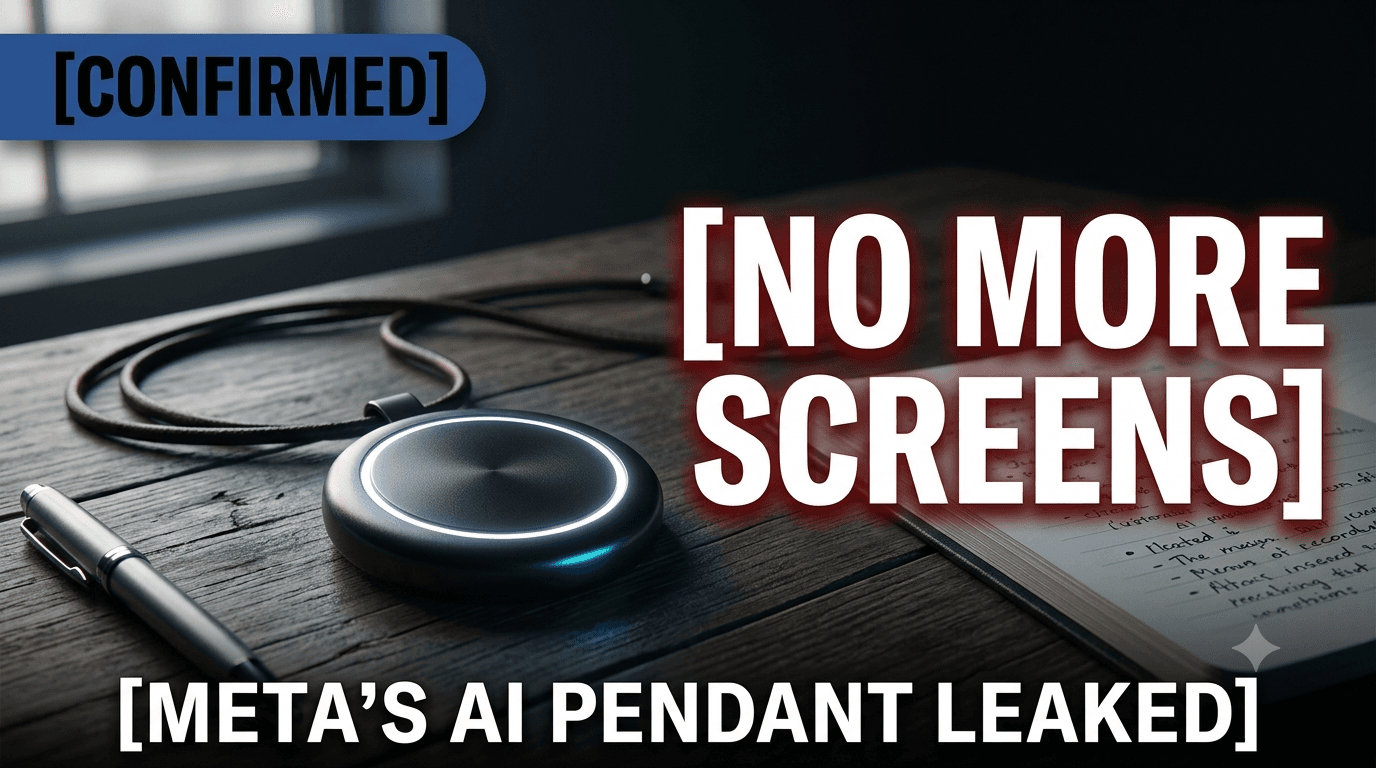
Meta's AI wearables strategy is no longer a rumor — it's a roadmap. A leaked internal memo, detailed by The Decoder and Engadget, lays out a clip-on AI pendant, as many as four new smart glasses models, and an enterprise service called Wearables for Work, all targeted through 2026. Taken together, it is the clearest signal yet that Meta believes the next personal computer won't have a screen at all.
The headline device is a pendant — small, worn, always listening. It builds directly on Meta's quiet late-2025 acquisition of Limitless, the startup whose clip-on recorder turned ambient conversation into searchable transcripts and daily recaps. If you want to see where ambient AI is heading, this is the device to watch.
What Meta is actually building
The leaked plan spans three product lines, each aimed at a different slice of the market.
The AI pendant is the boldest. According to reporting from Gizmochina and TechRepublic, it is designed to capture the audio around you throughout the day and turn it into transcripts, meeting recaps, and a searchable record of what you said and heard. It reportedly runs on Meta's AI model Muse Spark, paired with an unreleased agent codenamed Hatch.
On the eyewear side, Meta plans to ship up to four new smart glasses models before the end of 2026, with internal codenames including Modelo, Luna, RBM2 Refresh, and Mojito VIP. These extend the Ray-Ban line that gave Meta its first genuine wearable traction.
 futuristic AI wearable device close up.
The pendant that remembers everything
The pendant's entire pitch is memory. Where a smartphone makes you stop, unlock, and type, an ambient recorder captures context passively — the name you forgot, the deadline mentioned in passing, the idea you had on the walk to lunch.
That is the promise Limitless was built on, and Meta now owns the team. The trade-off is obvious and uncomfortable: a device whose whole value is that it is always on is also a device that is always listening.
Why a pendant, and why now
Meta's logic is that the phone has hit a ceiling. Screens demand attention; ambient AI asks for none. The bet is that an always-present layer of context — captured by a pendant or a pair of glasses — becomes more useful than yet another app.
The Limitless acquisition is the tell. Meta did not build the pendant from scratch; it bought a working product and a team that had already solved the hard problems of battery life, capture, and transcription. That is an acceleration play, not a science experiment.
It also reframes Meta's smart glasses. The Ray-Ban line was treated as a novelty. In this roadmap, glasses and the pendant are two expressions of the same thesis: that the interface of the next decade is worn, not held.
 person wearing minimalist tech pendant necklace.
Wearables for Work: the quiet enterprise wedge
The most underrated piece of the leak is not the pendant — it is Wearables for Work. Meta is reportedly targeting at least 10 companies for an enterprise wearables service, with deployments to at least two large organizations that each need 100 devices.
This is the smarter path, and it is where the strategy gets serious. Consumers balk at always-on recording in social settings. But a warehouse, a field-service crew, or a hospital floor has clear, bounded use cases where hands-free capture is a feature, not a creep factor. Enterprise adoption is how ambient AI crosses the chasm long before consumers are ready for it.
The numbers behind the bet are not modest:
- Meta aims to sell 10 million wearable devices in the second half of 2026.
- It is targeting 6.8 million monthly active wearable users by year's end.
- Up to four new glasses models plus the pendant, all inside a single year.
When a company sets a hard monthly-active-user target for a product category, it has stopped experimenting and started scaling.
What it signals for the post-smartphone era
Strip away the codenames and the through-line is clear: Meta thinks the interface of the next decade is something you wear. The pendant and the glasses are two bets on one idea — that ambient AI, always present and context-aware, can replace the deliberate act of pulling out a phone.
Whether that future is desirable is a separate question from whether it is coming. The roadmap says it is coming, and it puts a date on it.
 augmented reality smart glasses dark background.
The friction Meta still has to solve
Three problems stand between this roadmap and your collarbone.
Privacy is the obvious one. A device that records everyone around you — not just you — runs straight into consent laws and social norms that vary by country and even by state. The pendant is a legal grey zone walking into a room.
Social acceptance is subtler. Google Glass failed less on technology than on the discomfort of being recorded by a stranger. A pendant is less visible than glasses, which may make it more acceptable — or quietly more unsettling.
Battery and trust round it out. Always-on capture is a power problem and a security problem at the same time, and Meta is not the company most people instinctively trust with a recording of their entire day.
What to do with this signal
- If you build products: assume an ambient-capture layer is coming and design for a world where context is captured passively, not typed. The input model is changing.
- If you're an early adopter: watch the first Wearables for Work deployments, not the consumer launch — that is where the real capabilities will surface first.
- If you run an operations-heavy business: start scoping bounded, consent-clear use cases now (logistics, field service, clinical handoffs) so you're ready when the enterprise SKU ships.
- If you care about privacy: read your local two-party consent rules before you wear — or stand near — an always-on recorder.
Frequently Asked Questions
Is Meta's AI pendant available to buy?
No. As of mid-2026 it is an internal project reportedly slated for testing within the year, not a shipping product. The roadmap comes from a leaked memo rather than an official launch, so timing and features can still change.
What is Wearables for Work?
It is Meta's planned enterprise service bundling its AI glasses and wearables for business customers. Reporting indicates Meta is targeting at least 10 companies and deployments of 100 or more devices at large organizations.
What powers Meta's AI wearables?
The devices reportedly run on Meta's Muse Spark AI model alongside an unreleased agent codenamed Hatch. The pendant builds on technology and talent from Meta's 2025 acquisition of the ambient-recording startup Limitless.
Related Articles

Claude Code Steganography: Anthropic Is Embedding Hidden Data in Prompts—Here’s Why It Matters

HackerRank's Resume Score AI is Now Open Source. We Analyzed the Code to Reveal What Actually Matters.

The Unseen Challenger: How GLM 5.2 Quietly Dethroned Claude in Critical Cybersecurity Benchmarks