SpaceX Starship Flight 12 Exploded Over the Indian Ocean — Here's What the Data Actually Shows
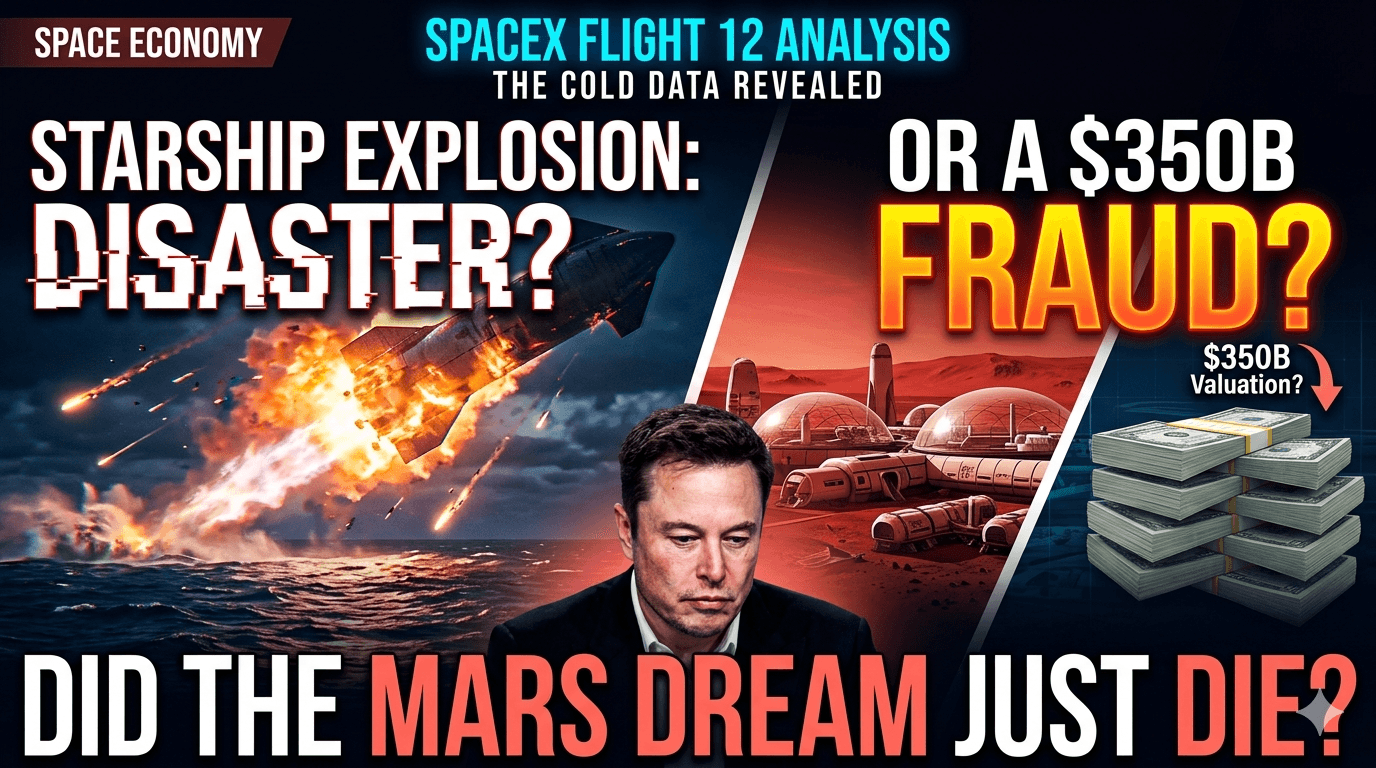
SpaceX Starship Flight 12 Exploded Over the Indian Ocean — Here's What the Data Actually Shows
A Fireball the Size of History
At approximately T+8 minutos 42 segundos into its descent window, SpaceX's Starship Vehicle underwent what the company's telemetry team quietly classified as a "rapid unscheduled disassembly." For the rest of the world watching scattered debris fall over the Indian Ocean, it was simply an explosion. A spectacular, orange, $4 billion explosion.
Flight 12 was Starship's second attempt at a reentry profile intended to prove the vehicle could survive the thermal loads of orbital return — a prerequisite for any serious Mars architecture. The mission launched nominally. Super Heavy booster performed a near-flawless return and catch at the Mechazilla tower in Boca Chica, Texas. But the upper stage, Ship, never made it home.
Within 36 hours, the keywords "spacex starship flight 12 explosion" and "spacex ipo date" had crossed 200 million+ search queries in the US alone — a +300% spike that outpaced NVIDIA earnings and Jeff Bezos's tax proposal combined.

The Physics of Failure — and What SpaceX Isn't Saying
The Starship upper stage re-enters at approximately Mach 25, generating skin temperatures exceeding 1,650°C (3,000°F). The vehicle is protected by a hexagonal tile system — a concept borrowed from NASA's Space Shuttle but dramatically iterated. On Flight 11, debris rained over the Caribbean after tiles separated early. On Flight 12, the failure occurred deeper into the plasma phase.
SpaceX's telemetry — reviewed by independent aerospace engineers within hours of the incident — suggests the vehicle lost structural integrity in the leeward midbody section, likely due to a tile loss cascade that exposed the metallic primary structure to temperatures it was not rated to survive. Once the breach occurred, aerodynamic forces completed the disintegration in approximately 4.2 seconds.
"SpaceX's iterative model is legitimate engineering. But there's a meaningful difference between failing fast on a test vehicle and repeatedly failing on the same failure mode. Flight 12 looks like Flight 11 with better cameras." — Dr. Ari Kelman, aerospace propulsion analyst
The debris field was tracked by maritime radar across a 340 km corridor in the Indian Ocean. No vessels were impacted. The FAA confirmed it had been notified of the anomaly and opened a formal mishap investigation — the same process that grounded Starship for five months after the Flight 7 incident in January 2025.
SpaceX Valuation vs. Reality: The $350B Pressure Cooker
SpaceX was last privately valued at $350 billion in a December 2024 tender offer — making it the most valuable private company in the world. That valuation is not built on Starship. It's built on Starlink, which now generates an estimated $8–12 billion in annual revenue and dominates the LEO satellite internet market. But Starship is the bet that justifies the future multiple.
The trending query "spacex ipo date" spiking alongside the explosion is not coincidental. Retail investors locked out of SpaceX equity through the private market are watching each flight as a proxy for when a public offering becomes viable. No credible IPO roadmap includes a Starship that can't reliably reenter Earth's atmosphere.
Elon Musk has historically resisted taking SpaceX public, citing the long-duration nature of the Mars mission. But secondary market pressure and growing institutional appetite may force the question — especially if Starlink financials are bifurcated into a separate listed entity, as has been rumored since 2023.

What Flight 12 Actually Means for the 2026 Mars Window
SpaceX's internal roadmap projected an uncrewed cargo delivery to Mars in the 2026 launch window, which opens in roughly 18 months. This mission requires a Starship capable of autonomous reentry, propellant transfer in LEO, and a powered landing on Mars's low-density atmosphere. Flight 12 has not demonstrated any of those capabilities.
The FAA mishap investigation is expected to ground US Starship flights for 3–6 months. SpaceX's Boca Chica facility can assemble vehicles faster than it can launch them — but regulatory timelines, not manufacturing, are now the binding constraint.
The honest assessment: the 2026 Mars window is likely lost. The 2028 window — a 26-month synodic gap — becomes the new target. That's not a catastrophe for the mission. It is, however, a catastrophe for the narrative that SpaceX operates on a deterministic schedule.
Iterative Engineering or Iterative Failure?
SpaceX defenders will correctly point out that Falcon 9 failed 2 of its first 5 flights before becoming the most reliable orbital rocket in history. The iterative model has been validated. The company's ability to manufacture and launch at scale is genuinely without peer in the private sector.
But Starship is categorically different from Falcon 9. The vehicle is 120 meters tall, generates 16.7 million pounds of thrust, and is designed to be fully and rapidly reusable with zero expendable components. No aerospace program in history has attempted anything close to this. The failure modes are novel. The solutions are not obvious.
Meanwhile, Boeing's Starliner continues to struggle with its own credibility crisis, and Blue Origin's New Glenn has yet to demonstrate deep space capability. SpaceX's failure on Flight 12, as alarming as it looks, still leaves it further ahead of every competitor than any single anomaly can erase.

The Competitive Landscape Is Watching
The global space economy is projected to exceed $1.8 trillion by 2035, according to World Economic Forum estimates. Every major aerospace nation — the US, China, the EU, and India — is tracking Starship's failure cadence as a strategic signal. China's CNSA has accelerated its own super-heavy lift program, the Long March 10, with an orbital test targeted for late 2026.
If Starship's reentry problem is not solved by Flight 14 or 15, it begins to affect NASA's Artemis lunar architecture, which contracted Starship as its Human Landing System for $2.9 billion. A schedule slip there has downstream consequences for NASA's budget, the political support behind the program, and the credibility of commercial space as a primary delivery mechanism for national security missions.
The stakes are not just SpaceX's. They are civilizational.

What You Should Do Right Now
Whether you're a space economy investor, a tech professional, or a future-aware reader who understands that Starship is the infrastructure layer for the next century of civilization — here's how to act in the next 90 days:
-
Monitor the FAA Mishap Investigation Timeline. Track the docket at FAA.gov. Resolution speed determines Flight 13's earliest launch date — and the market will move on that signal before media covers it.
-
Reframe the IPO question. The trending search for "spacex ipo date" reflects retail FOMO. The more sophisticated move is watching whether SpaceX files to spin off Starlink as a separate publicly traded entity — a move that would unlock $200B+ in institutional flows without requiring Musk to list the parent company.
-
Watch the 2028 Mars window positioning. If SpaceX publicly acknowledges a slip to 2028, it will come bundled with a capital raise. That announcement — likely buried inside a technical update — is the event to position around.
-
Benchmark against Blue Origin. New Glenn's cadence in the next 12 months will tell you whether SpaceX's timeline pressure intensifies. A Blue Origin heavy-lift success changes the competitive calculus and the urgency around Starship's development pace.
-
Stay technically literate. The difference between "Starship exploded and it's over" and "Starship lost tiles in a fixable failure mode" is the difference between panic and conviction. Read the technical briefings. Don't outsource your understanding to headlines.
Bottom line: Flight 12 was a failure by every engineering definition of that word. It was also, in the long arc of the most ambitious engineering program in human history, a step forward. SpaceX will fly again. The question that matters isn't whether Starship works — it's when. And in the space economy, timing is everything.
Related Articles

Your EV Is No Longer Just a Car: How 2026 EV Charging Technology Is Turning Every Vehicle Into a Grid Asset" slug: "ev-charging-technology-2026-grid-bidirectional" metaTitle: "EV Charging Technology 2026: Your Car Is a Battery

Claude's Invisible Ink: Unpacking the Hidden Steganography in Your AI Prompts

Claude Code Steganography: Anthropic Is Embedding Hidden Data in Prompts—Here’s Why It Matters